
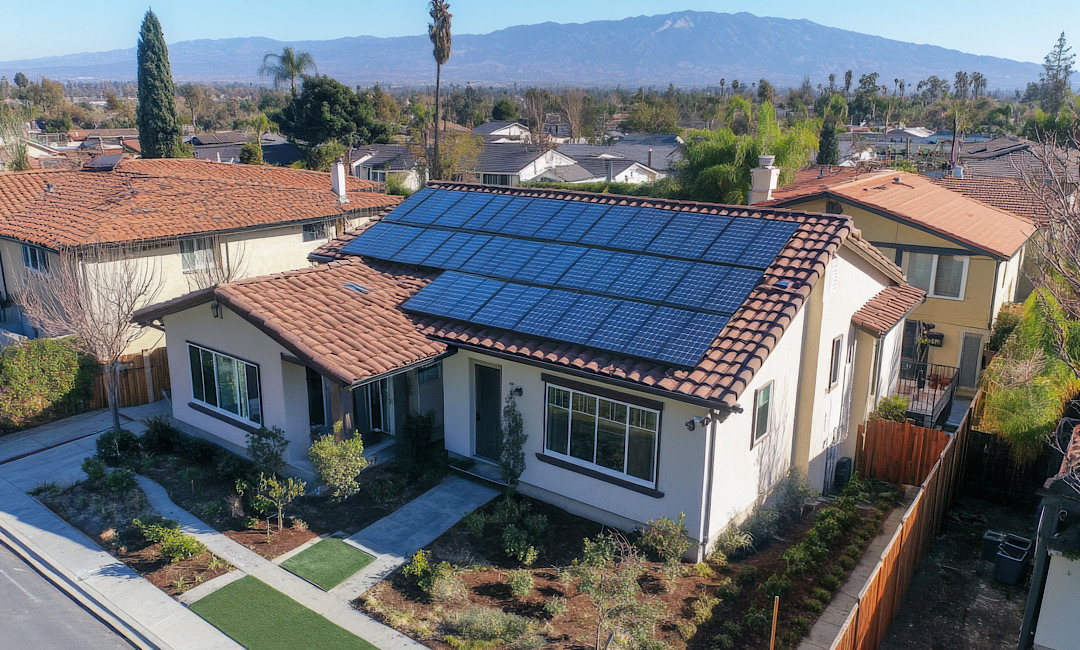
Size your solar to your real-life energy habits—then plan for what you’ll add next (battery, EV, heat pump).
“Bigger” isn’t always better in California—especially with modern net billing rules that reward smart self-consumption. The best solar system sizing starts with your actual usage (kWh), your roof’s production potential, and your near-future plans (EV charging, battery backup, or electrical panel upgrades). This guide breaks down a clean, engineer-friendly way to size a home solar system based on usage for homeowners in Dublin, Pleasanton, Castro Valley, San Ramon, Livermore, and the greater East Bay—without relying on tax credit messaging.
Why “usage-based” sizing matters more than ever in California
Most homeowners start with one question: “How many solar panels do I need?” The more accurate question is: “How many kilowatt-hours (kWh) do I want to offset—and when do I use them?” Under California’s current net billing structure, daytime exports can be valued differently than evening consumption, so aligning production with your household load profile (and adding storage where it makes sense) can outperform a system that’s simply oversized.
It also helps you hedge against utility price volatility. PG&E has announced rate decreases going into early 2026, but household bills remain high relative to prior years, and long-term predictability is still a big driver for homeowners choosing solar + batteries.
Step 1: Pull the right number from your bill (annual kWh)
Usage-based sizing starts with your annual electricity consumption, measured in kWh/year. If you can, collect 12 months of bills (or your utility usage report) to capture seasonality—hot summer A/C spikes are common in the Tri-Valley.
Quick check:
If your bills show 500 kWh/month on average, your annual usage is about 6,000 kWh/year. PG&E has referenced 500 kWh/month as a “typical” residential usage benchmark in recent rate communications.
Step 2: Convert kWh/year into system size (kW) using production assumptions
Solar panels are rated in kilowatts (kW) of power, but your goal is to produce kilowatt-hours (kWh) of energy over time. Converting your annual kWh target into a kW system size depends on local sun, roof orientation, shading, and equipment efficiency.
| Your annual usage (kWh/year) | Simple sizing range (kW)* | Approx. panel count (400W panels)** | Best fit household example |
| 6,000 | ~4–5 kW | 10–13 panels | Smaller home, gas appliances, modest A/C |
| 9,000 | ~6–7 kW | 15–18 panels | Typical family, heavier summer cooling |
| 12,000 | ~8–10 kW | 20–25 panels | Large home, work-from-home load, pool pump |
*Sizing ranges are “sanity-check” estimates. A proper design uses site-specific modeling for your roof planes and shading.
**Panel counts vary with panel wattage, setbacks, and roof layout.
Step 3: Decide what you’re trying to offset (and what you’re adding next)
A usage-based design gets sharper when you choose an offset target: partial offset (e.g., 60–80% of annual kWh) vs. near-full offset (90–110%). In the East Bay, many homeowners choose a “right-sized” solar array plus battery storage to increase onsite use and reduce exporting at low-value times.
If you’re adding an EV (or a second EV)
EV charging can add a meaningful chunk of annual kWh. The clean approach is to estimate your annual miles and charging pattern, then size solar/battery for that “new load” rather than guessing. If your electrical panel needs more capacity, plan that upgrade before or alongside solar.
EV charger installation in Pleasanton
If you want resiliency + energy independence
A battery can keep critical loads running during outages and can shift solar energy into evening hours when households typically use more electricity. In California, pairing storage with solar often improves “real” savings by increasing self-consumption.
Step 4: Confirm your home can support the system (panel capacity, sub-panels, and service)
Your “perfect” solar size on paper may run into a practical limit: your main service panel and breaker capacity. This comes up a lot in Dublin and Pleasanton homes where homeowners want to add solar, a Level 2 EV charger, and a battery—sometimes all within the same year.
Common signs you may need an upgrade
• Panel is full (no breaker space) or uses older equipment
• You’re adding EV charging + solar + battery
• You want dedicated circuits for critical loads
• You’re seeing nuisance trips or heat damage
Related services (in-house)
Main panel upgrades Sub-panel upgrades
How Sunlight Electri-Cal Solutions approaches sizing (clear, in-house, no handoffs)
A reliable sizing process should feel transparent, not mysterious. Our team in Dublin designs and installs solar and electrical upgrades in-house—so the system is sized with your roof, your electrical infrastructure, and your long-term plan in mind (not just a sales number).
A simple, homeowner-friendly sizing checklist
1) Get 12 months of kWh usage (and note summer peaks).
2) Identify future loads (EV, heat pump, hot tub, pool, home office).
3) Evaluate roof production (azimuth, tilt, shading, available planes).
4) Decide your strategy: solar-only vs. solar + battery for higher self-use.
5) Confirm electrical readiness (main panel, sub-panel, breakers, service size).
6) Keep it serviceable: choose equipment that’s easy to monitor and maintain.
Residential solar panel installation in Pleasanton Service an existing solar system
Local angle: Dublin & Tri-Valley sizing considerations (Pleasanton, Livermore, San Ramon, Castro Valley)
In the Tri-Valley and East Bay, sizing often comes down to three local realities: (1) hotter inland summer afternoons that drive A/C usage, (2) commuter patterns that push EV charging into evenings, and (3) outage preparedness for households that want critical loads protected. If your household uses more energy after sunset, a battery-focused design can improve comfort and predictability—especially when paired with an electrical layout that supports critical-loads backup.
Want a right-sized solar plan based on your bills?
Get a clear recommendation for solar system sizing based on your usage, roof layout, and upcoming upgrades (battery backup, EV charger, main panel, or sub-panel). No pressure—just straightforward guidance from a local Dublin team.
Meet the Sunlight Electri-Cal Solutions team
FAQ: Solar system sizing based on usage
How do I size solar panels based on my electric bill?
Start with 12 months of total kWh usage. Then translate that annual kWh into an estimated system size (kW) using local production assumptions for your roof (sun exposure, shading, orientation). A site-specific design tool can tighten the estimate and prevent over/under-sizing.
Is it better to oversize a solar system in California?
Not automatically. If you export a lot of energy to the grid during low-value times, you may see diminishing returns. Many homeowners do better with a right-sized array plus a battery (or load shifting) to increase onsite usage.
What if I’m getting an EV within the next year?
Tell your installer up front. EV charging can meaningfully increase annual kWh. We typically model the “future load” so the solar design and your electrical panel capacity match what you’ll actually use.
Do I need a main panel upgrade to install solar?
Sometimes. It depends on your panel rating, breaker space, load calculations, and the interconnection method. If you’re adding solar, battery backup, and a Level 2 EV charger, a panel or sub-panel upgrade can simplify the design and improve safety.
Can you service or expand an existing solar system?
Yes. If your usage has changed (new EV, growing family, home office), we can evaluate performance, troubleshoot components, and discuss expansion paths that make sense for your roof and electrical infrastructure.
More solar questions? Visit our FAQ page
Glossary (quick definitions)
kW (kilowatt)
A measure of power (how much electricity a system can produce at a moment). Solar “system size” is typically listed in kW.
kWh (kilowatt-hour)
A measure of energy over time (what you actually consume on your bill). Usage-based sizing starts here.
Self-consumption
The portion of solar energy you use directly in your home instead of exporting to the grid. Batteries and load shifting can raise this.
Main panel (service panel)
Your home’s primary breaker panel. Its rating and available breaker capacity can affect solar, battery, and EV charger installation options.
Sunlight Electri-Cal Solutions proudly services Dublin, San Jose, Castro Valley, Fremont, Pleasanton, and surrounding communities throughout the region.